










Delhi Office: 62, Pockt-4, Dwarka,
New Delhi 110075

By Tutor Chahiye
Maths
20 Oct, 2026
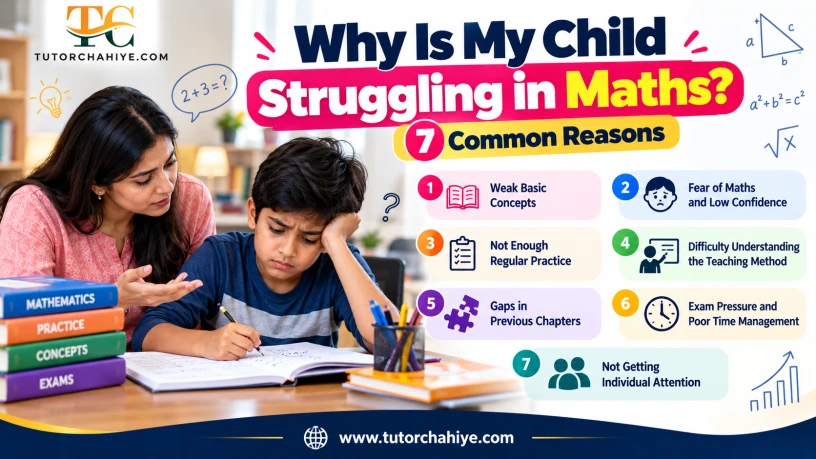
Is your child finding Maths difficult despite spending hours studying? Do they struggle with homework, make repeated mistakes or feel nervous before Maths exams? Many parents face these challenges and wonder what they can do to help.
If your child is struggling in Maths, it does not necessarily mean they lack ability. Sometimes, the problem is weak basic concepts, limited practice, fear of making mistakes or a teaching method that does not suit their learning style.
Let's explore seven common reasons why children struggle with Maths and how parents can support them.
Maths is a subject where one concept builds on another. If a student has difficulty understanding fractions, multiplication, decimals or basic calculations, advanced topics can become confusing.
According to Khan Academy's guide to addressing gaps in Maths learning, identifying and strengthening foundational skills is important for helping students progress.
What parents can do: Identify the topics your child finds difficult and revise the basics before moving to advanced chapters.
Some children believe they are simply not good at Maths. After receiving low marks or making repeated mistakes, they may become anxious about solving questions.
The educational resource Understood explains that Maths anxiety can affect a student's ability to perform, even when they understand the material.
What parents can do: Encourage your child to treat mistakes as learning opportunities. Appreciate their effort and progress instead of focusing only on marks.
Understanding a formula during class is different from applying it independently. Students need regular practice to remember methods and solve different types of questions.
Long study sessions just before exams may not be enough to develop confidence.
What parents can do: Encourage 20–30 minutes of focused Maths practice each day, adjusting the duration to your child's age and needs. Regularly review mistakes and practise similar questions.
Every child learns differently. Some understand concepts through visual examples, while others need step-by-step explanations or practical activities.
If a student cannot follow the teacher's explanation, they may memorise formulas without understanding how to use them.
What parents can do: Ask your child which topics feel confusing. Try alternative explanations, worked examples and visual learning resources such as Khan Academy India, which offers Maths learning resources for students in Grades 1–12.
Sometimes, a student struggles with a new chapter because they have not fully understood an earlier topic. For example, difficulty with fractions can create problems when learning percentages, ratios or algebra.
Moving forward without addressing these gaps can make Maths increasingly difficult.
What parents can do: Review previous chapters and identify exactly where the confusion begins. Strengthening those skills can make current lessons easier to understand.
Some students understand Maths during practice but struggle to solve questions during examinations. Nervousness, rushing and spending too much time on one problem can affect their performance.
What parents can do: Introduce timed practice gradually. Teach your child to read questions carefully, show working steps and move to another question when they get stuck.
In a busy classroom, teachers may not always have enough time to address every student's individual difficulties. A child who falls behind may continue struggling without receiving targeted support.
What parents can do: Speak with the schoolteacher to understand your child's difficulties. If additional guidance is needed, consider a home tutor who can explain concepts at your child's pace, solve doubts and provide focused practice.
A home tutor can identify weak areas, explain difficult concepts using different methods and create a learning plan based on the student's needs. Regular feedback can also help parents understand their child's progress.
However, the right support depends on the reason behind the difficulty. Some students need extra practice, while others need foundational revision or help managing Maths anxiety.
If your child is struggling in Maths, avoid comparing them with other students. Start by identifying the problem, strengthening basic concepts and creating a regular practice routine.
With patience, suitable teaching methods and consistent support, children can gradually improve their understanding and confidence.
Looking for personalised Maths support for your child? Visit TutorChahiye.com to explore tutoring options that match your child's class, learning needs and academic goals.
Copyright © Tutor Chahiye
